

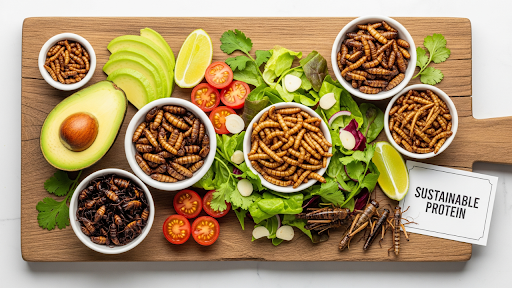
Have you ever wondered if there’s a more sustainable way to satisfy your hunger?
With growing concerns about climate change, food security, and resource depletion, the search for eco-friendly food options has never been more urgent. One surprising and innovative solution is the use of edible bugs. These tiny creatures are not only rich in protein but also offer numerous environmental benefits. By choosing edible bugs, you’re making a conscious choice to support sustainability.
This article will explore why edible bugs are a sustainable food choice.
1. Low Environmental Impact
Edible bugs are incredibly efficient in terms of resource utilization. Unlike traditional livestock, insects require far fewer resources to produce, such as water, food, and land. The environmental footprint of farming insects is significantly smaller than that of cattle, pigs, and chickens. For example, crickets need about six times less feed than cattle to produce the same amount of protein. This translates into fewer greenhouse gas emissions and significantly reduced water usage.
Environmental Benefits:
- Less land and water usage compared to conventional meat production.
- Lower greenhouse gas emissions.
- Efficient feed-to-protein conversion makes it a sustainable choice for the planet.
2. Reduced Land Use
Insects, unlike traditional livestock, do not require vast areas of land for grazing. They can be farmed in controlled environments such as vertical farms or containers, making them ideal for urban farming or places with limited agricultural space. This not only reduces deforestation but also ensures that food production doesn’t compete with natural habitats.
Advantages of Reduced Land Use:
- No need for vast grazing areas.
- It can be farmed in confined spaces, such as urban or vertical farms.
- Conserves natural ecosystems by limiting land encroachment.
3. Highly Efficient Feed Conversion
One of the key reasons insects are considered a sustainable food choice is their highly efficient feed conversion rate. For every kilogram of feed, insects produce significantly more edible biomass than traditional livestock.
For instance, crickets can be raised with far less feed, and the feed they consume can often be made from organic waste, making the process circular and waste-reducing. If you’re looking to incorporate sustainable food into your diet, consider checking out edible bugs for sale as an excellent alternative to traditional protein sources.
Feed Efficiency Benefits:
- Insects require much less feed to produce the same amount of protein as traditional livestock.
- Use of organic waste as insect feed helps recycle food scraps.
- Less resource-intensive farming contributes to environmental preservation.
4. Sustainable Protein Source
As the global population continues to grow, finding new and sustainable protein sources becomes increasingly crucial. Edible bugs are an excellent alternative to conventional animal protein. They provide high-quality protein, essential amino acids, and micronutrients, including iron and calcium. By turning to edible bugs, you help reduce the strain on our overburdened food systems.
Protein Benefits:
- Rich in protein and essential nutrients like iron and calcium.
- Healthier and more efficient than traditional meat sources.
- A reduction in reliance on industrial-scale animal farming decreases environmental pressure.
5. Lower Carbon Footprint
The carbon footprint of raising edible bugs is significantly lower compared to traditional meat production. This is because insects require far less energy to farm, and they emit fewer greenhouse gases. Insects naturally produce fewer emissions than cattle or pigs, making them a more environmentally friendly source of nutrition.
Carbon Footprint Benefits:
- Lower methane emissions compared to livestock.
- Requires minimal energy to farm compared to traditional animal farming.
- A greener option for climate-conscious consumers.
6. Waste Reduction Potential
Edible insects are also part of a more sustainable food system because they can be fed organic waste, which would otherwise go to landfills. By turning food scraps, agricultural by-products, and even food waste into nutritious insect protein, we help minimize waste while creating a valuable food source.
Waste Reduction Advantages:
- Insects can feed on food scraps and organic waste.
- Helps divert food waste from landfills, reducing pollution.
- Promotes a circular economy by transforming waste into valuable food.
7. Biodiversity Preservation
Insect farming helps preserve biodiversity by reducing the need for monoculture crops or livestock farming. With insects, you can achieve high yields without harming biodiversity or overexploiting natural resources. The diversity of edible insect species enables farming that does not rely on the same crops or livestock, which can prevent soil degradation and ecosystem imbalance.
Biodiversity Benefits:
- Supports agricultural biodiversity by diversifying food production.
- Requires fewer pesticides and chemicals than traditional farming.
- Promotes healthier ecosystems by reducing reliance on large-scale monoculture.
Conclusion
Edible bugs offer an innovative and sustainable solution to the world’s food challenges. They require fewer resources, have a smaller environmental impact, and provide a rich source of protein and nutrients. As global food demand rises and the need for sustainable solutions intensifies, edible bugs are emerging as a key player in building a more sustainable food system.
So, next time you come across edible bugs for sale, consider the benefits they offer to both your health and the planet.

Comments are closed.